What to buy
Stainless Steel Farmhouse Sinks: Worth It, If Your Cabinet Is Ready
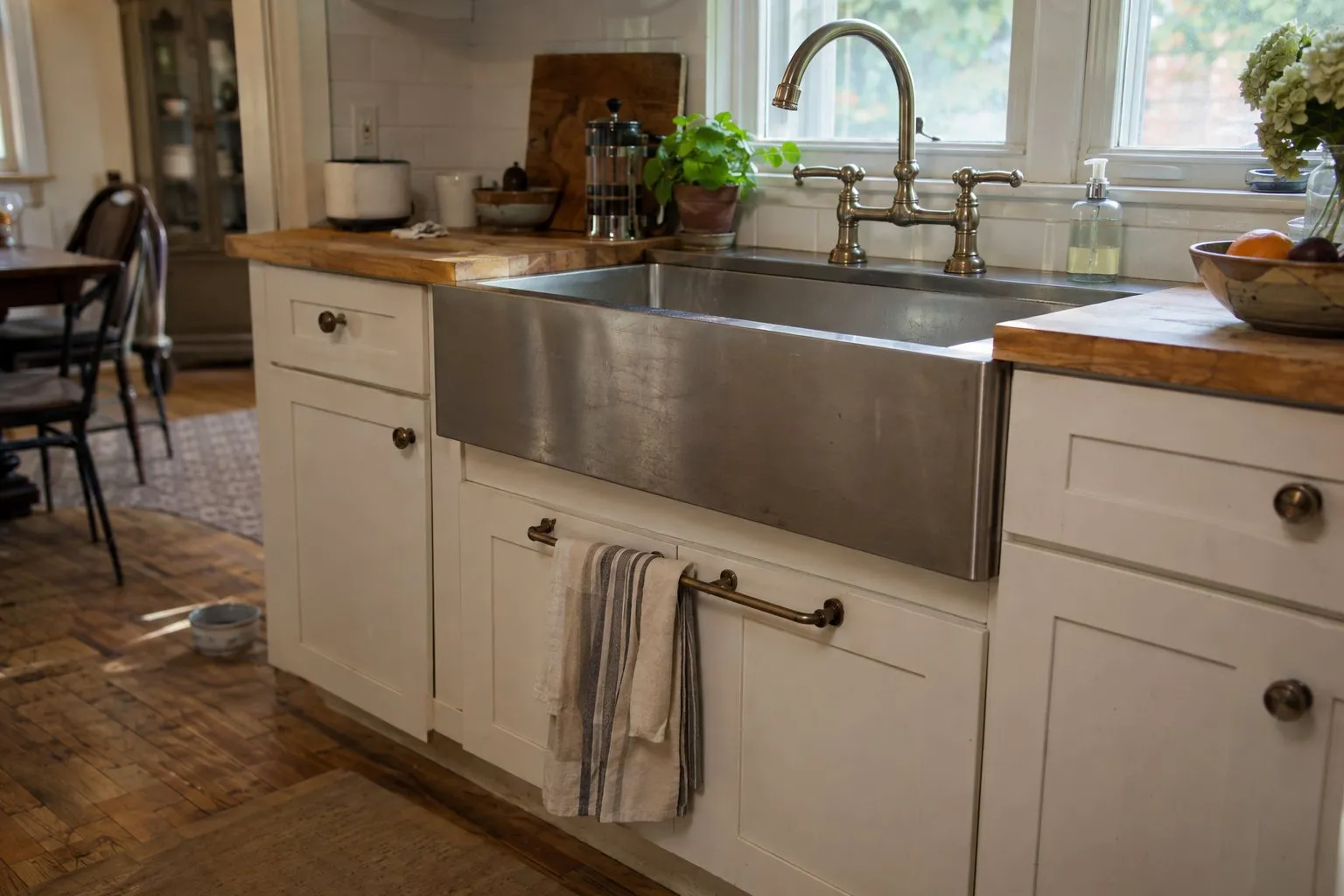
A farmhouse sink shows its front and rests on supports inside the cabinet, so buy the cabinet plan along with the sink. In steel, you get the look with no glaze to chip. Our pick is the KRAUS KHF200-33, in a 36-inch base.
Disclosure: This page contains affiliate links (marked with *). If you buy through them, we earn a small commission at no extra cost to you. As an Amazon Associate I earn from qualifying purchases. Learn more
In short
A stainless steel farmhouse sink is an apron-front sink in sheet steel. It needs a cabinet built or reworked to hold it, with supports inside. Our pick is the KRAUS KHF200-33. KRAUS's 2020 manual says a 33-inch minimum cabinet and its 2017 guide says 3 inches wider than the sink, so plan on 36. KRAUS advises against laminate counters.
On this page
KRAUS
KRAUS KHF200-33
The apron look in steel, far lighter to support than cast iron or thick fireclay.
Why here: It's the farmhouse look in steel from a maker that publishes the whole install, including what it doesn't recommend.
Best for: A farmhouse look without the worry of a chipped bowl, in a cabinet built for it.
- Steel can't chip like a glazed bowl
- Bottom grid and basket strainer included
- Sold in 30, 33 and 36 inch widths
- KRAUS says not to pair it with laminate
- You build supports and cut the cabinet front
- KRAUS's own papers disagree on the cabinet size, so plan on 36 inches
- Mounting
- Apron-front, set under the counter
- Minimum cabinet
- 33 in in the 2020 manual; 2017 guide says 3 in wider than the sink
- Outside size
- 32-7/8 × 20-3/4 × 10 in
- Bowl
- Single
- Material
- 16-gauge stainless steel, per listing
- In the box
- Bottom grid, basket strainer, template
- Price class
- Premium
Before you fall for one
A farmhouse sink replaces the top of the cabinet front. It rests on supports inside the cabinet, and a countertop is cut around it. That means three jobs beyond the sink itself: a cabinet ready for it, supports inside, and a counter cut to fit. Our page on existing cabinets says when your current cabinet can be saved.
Which farmhouse sink?
Which one?
If you want the look without a glaze to chip → KRAUS KHF200-33
View(paid link to Amazon, opens in a new tab)Ad · paid link · check price & delivery on AmazonIf you want classic white fireclay in a 36-inch base → Ruvati RVL2300WH
View(paid link to Amazon, opens in a new tab)Ad · paid link · check price & delivery on AmazonIf you want enameled cast iron and your cabinet is built for it → Kohler Whitehaven
View(paid link to Amazon, opens in a new tab)Ad · paid link · check price & delivery on AmazonIf you only have room for a 33-inch base
| Comparison | Our pick: stainless farmhouseKRAUS KHF200-33 | Our pick: fireclay farmhouseRuvati RVL2300WH | Kohler Whitehaven |
|---|---|---|---|
| Mounting | Apron-front, set under the counter | Apron-front | Undermount apron-front |
| Minimum cabinet | 33 in in the 2020 manual; 2017 guide says 3 in wider than the sink | 36 in | 36 in apron base |
| Outside size | 32-7/8 × 20-3/4 × 10 in | 32-3/4 × 20-1/4 × 10-1/4 in | 35-3/4 in nominal |
| Bowl | Single | 30-3/4 × 18-1/4 in, single | 30-3/4 × 18-1/16 in, single |
| Bowl depth | – | 8-3/4 in | 9 in |
| Material | 16-gauge stainless steel, per listing | Fireclay, 1 in thick | Enameled cast iron |
| In the box | Bottom grid, basket strainer, template | Rinse grid, drain assembly, install guide | – |
| Price class | Premium | Premium | Premium |
| Best for | A farmhouse look without the worry of a chipped bowl, in a cabinet built for it. | A classic white apron sink in a true 36-inch farmhouse base. | A premium kitchen build with a 36-inch apron base already planned. |
| On Amazon(paid link to Amazon, opens in a new tab)Ad · paid link · check price & delivery on Amazon | On Amazon(paid link to Amazon, opens in a new tab)Ad · paid link · check price & delivery on Amazon | On Amazon(paid link to Amazon, opens in a new tab)Ad · paid link · check price & delivery on Amazon |
KRAUS KHF200-33
A single bowl in steel, 32-7/8 by 20-3/4 inches and 10 inches tall, with a bottom grid and basket strainer. The Amazon listing gives 16 gauge. It's also sold in 30 and 36 inch widths, and KRAUS's manual has the same steps for all of them.
Buy it if you want the shape and a material that won't chip. Skip it if your counter is laminate, or if you'd love a white sink, in which case you won't be happy with steel for long.
Ruvati RVL2300WH and the other fireclay
White fireclay is the classic, and Ruvati's has a front you can install flat or fluted. It is a different material with different care. Our fireclay page covers it, and fireclay vs stainless steel compares the two.
Kohler Whitehaven
Enameled cast iron, with an apron that overlaps the cabinet face so that the cut needn't be perfect, which Kohler calls Self-Trimming. It needs a 36-inch apron base, and the drain is sold separately. It sits in the premium class. Read more on our Kohler page.
Steel, fireclay or cast iron?
The shape is the same, but the material changes how you live with it. Stainless steel suits a modern kitchen, with straight apron lines, Signature Hardware says. It's the one here with no glaze to worry about. KRAUS's care advice for it is simple: mild soap, a rinse and a dry, and no steel wool or chlorine.
Fireclay is clay fired above 2,000 degrees F, per Signature Hardware. It's thick and usually white, with a flat front, though fluted fronts exist. KRAUS asks you to keep hot pans off it and not to leave coffee grounds or tea bags sitting on it. Enameled cast iron, like the Kohler, is the heavyweight of the group, and Magnus says it needs internal cabinet supports.
One bowl or two?
Signature Hardware says single bowls are more common in this shape, which suits big pans. All three picks here are single bowls. A double separates food prep from dirty dishes, but you'd give up the wide, deep space that often draws people to a farmhouse sink. If you're unsure, single or double goes through it.
Is it worth the work?
It depends what you're starting with. In a remodel, with new cabinets on order, you're simply telling the cabinet maker what to build. In a finished kitchen, The Sink Boutique lists a reworked cabinet front, cut-down doors, new supports, and possibly a new counter and rerouted drains.
If that second list is more than you want to take on, you have two options. A retrofit sink has a shorter apron, made to fit existing cabinets with less work. Or you could stay with a regular undermount, which gets you a big single bowl, the 10-inch depth and no cabinet work, though not the look.
What to check
- The cabinet. New, or reworked? Sizes and cabinets lists what each sink needs.
- The doors. Most farmhouse sinks are about 9 to 10 inches deep, The Sink Boutique says, so the doors below get shorter.
- The faucet. Most have no holes, so it goes on the counter or wall.
- The installer. KRAUS recommends a licensed professional. Our install overview shows what the job involves.
Wondering whether "apron" means something different? It mostly doesn't, as apron vs farmhouse explains. To compare with ordinary mounting styles, go to undermount or drop-in. For steel, start with the KRAUS KHF200-33*.
Asked before buying
Are stainless steel farmhouse sinks a good idea?
They're a good idea if you want the apron look and you dislike the thought of chipping a glazed bowl. Steel has no glaze to chip, though it does scratch. You still need a cabinet prepared for it, so count that in. The look is more modern too, with straight lines on the apron, as Signature Hardware notes.
Do farmhouse sinks need a special cabinet?
They need a custom cabinet or custom support in an existing one, Signature Hardware says, since the sink rests fully on that support and isn't attached to the counter. It suggests a base cabinet about 3 inches longer than the sink, which leaves room for trim and bracing.
Where does the faucet go on a farmhouse sink?
Behind the sink. Most farmhouse sinks have no faucet holes, Signature Hardware says, so the faucet mounts on the counter or on the wall. Decide that before the counter is cut, and leave enough room behind the bowl.
Can a farmhouse sink go on a laminate counter?
KRAUS says its stainless farmhouse sinks are not recommended with laminate. The counter edge around the sink is exposed and in the wet, the same issue as with an undermount. If you have laminate and want this look, plan on a counter change as part of the job.
Where this comes from
Read next
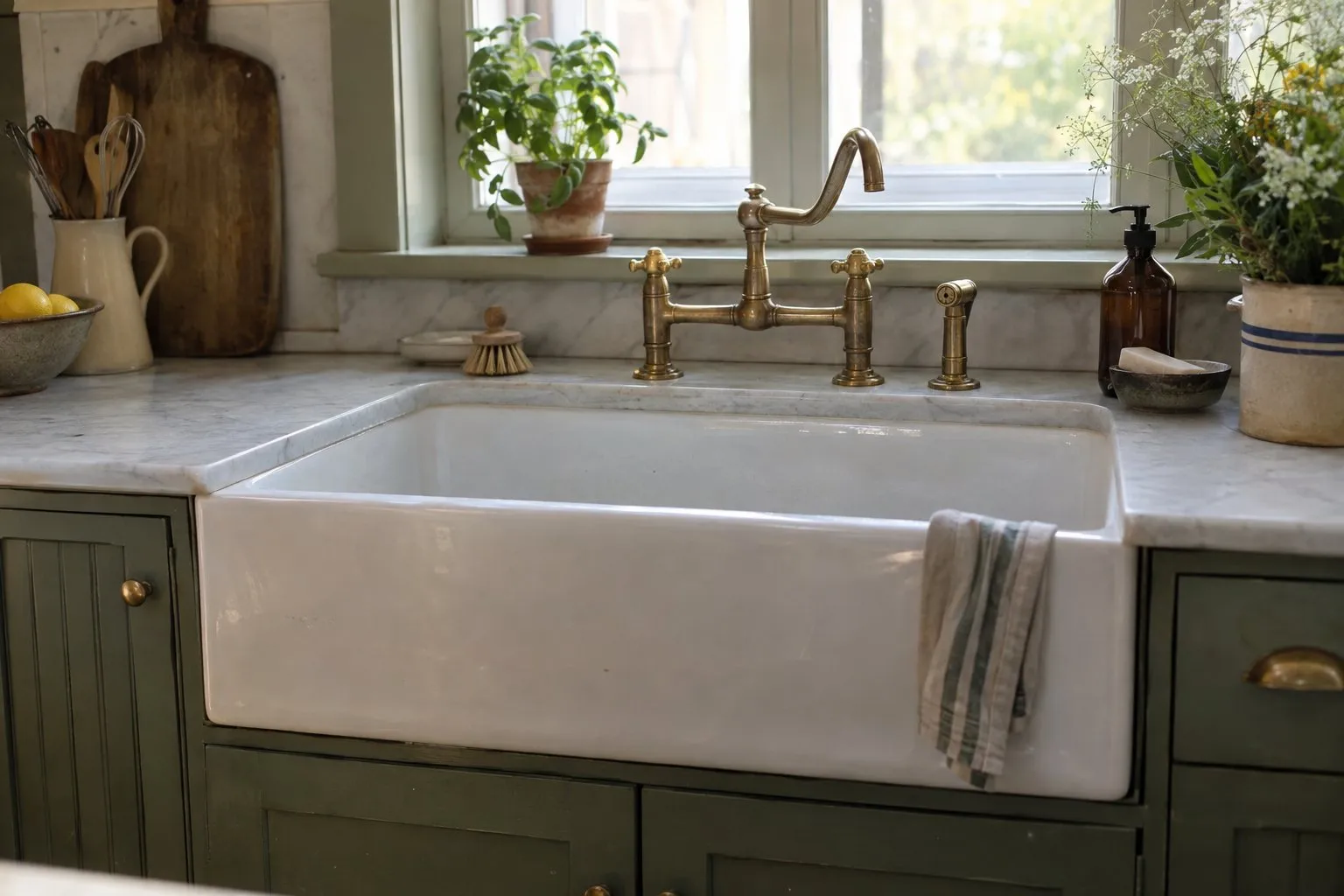 What to buyFireclay farmhouseFireclay farmhouse sinks: why they're heavy, what they need from your cabinet, how to care for them, and which to choose for a 36-inch or a 33-inch base.
- Good to knowIn an existing cabinetA farmhouse sink can go in a standard cabinet, but the front gets reworked and the doors cut down. What's involved, when a retrofit sink is the better route.
- Good to knowSizes and cabinetsFarmhouse sink sizes with the cabinet makers ask for: 30, 33 and 36 inch sinks from KRAUS, Ruvati, BOCCHI and Kohler, and why you should plan for 3 inches extra.
- How toHow it's installedHow a farmhouse sink gets installed, following KRAUS's manual: supports, cabinet cut, reveal, counter cut and plumbing, and who should do which part.
- ComparisonApron or farmhouseApron vs farmhouse sink: the words mostly mean the same sink. What each one really describes, and what to check instead of the name before you buy one.
Who writes this
stainlesssteelkitchensink.com Editorial Team
Kitchen sinks & fit
We are the editorial team at stainlesssteelkitchensink.com. We read makers' spec sheets, install manuals and care guides and turn them into plain-English buying advice, with sources on every page. We do not run lab tests, and we say so openly.
- Spec sheets & standards read
- Sources on every page
- No lab tests – stated openly
- Publisher details in the imprint