How to
Installing a Farmhouse Sink: What the Job Involves
The order matters: supports first, then the cabinet front, then the sink, and only then the counter. KRAUS recommends a licensed professional, so read this as a guide to what the job involves. Your sink's own manual overrides anything here.
Disclosure: This page contains affiliate links (marked with *). If you buy through them, we earn a small commission at no extra cost to you. As an Amazon Associate I earn from qualifying purchases. Learn more
In short
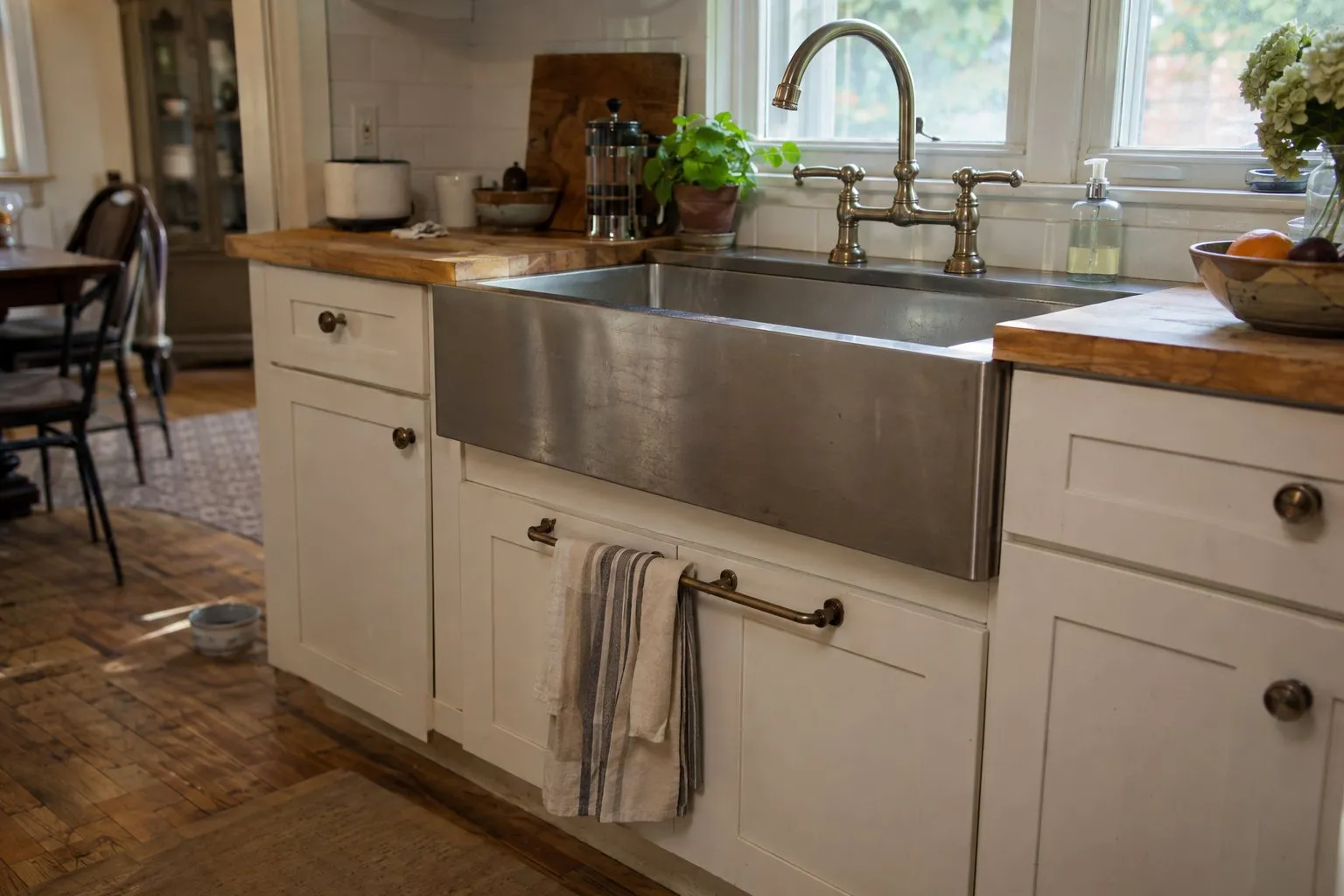
A farmhouse sink goes in this way, per KRAUS's manual: build supports inside the cabinet, cut the cabinet front to fit the apron, set and level the sink on the supports, choose the reveal, cut the counter to fit, seal with silicone, connect the plumbing and check for leaks. KRAUS recommends a licensed professional and advises against laminate counters.
On this page
This follows KRAUS's manual for its KHF farmhouse sinks. Other sinks differ, and Kohler's Whitehaven for one has its own Self-Trimming front.
The steps, in order
Measure and build the supports
Build a frame inside the cabinet that takes the sink's whole weight. KRAUS names 1-1/4-inch angle irons, 2×4s and 3/4-inch plywood.Cut the cabinet front
Cut the front to fit the apron. KRAUS says to add 1/16 inch to the apron height. Mark twice, because a cut here can't be undone.Set and level the sink
Set the sink on its supports and level it. The Sink Boutique says shims can adjust it.Choose the reveal
KRAUS offers three: 3/8 inch positive, which it recommends, plus zero, and 1/8 inch negative.Cut the counter
The counter is cut to fit around the sink. With stone or quartz this is a fabricator's job.Seal it
Run silicone along the joint between sink and counter.Connect the plumbing and check for leaks
Connect the drain and supply lines, and run water to check every joint. The Sink Boutique says the drain lines may need rerouting.
Who does what
| Part of the job | Who you may need |
|---|---|
| Supports and cabinet front | A cabinet maker or carpenter |
| Doors | A cabinet maker, or new doors |
| Counter cut | The counter fabricator |
| Drain and water | A plumber |
The list is our way of thinking about it, so ask your installer which parts they cover.
The weight question
Don't guess at this one. The sink rests entirely on the supports. How heavy is a farmhouse sink has the figures we found, and Magnus says cast iron especially needs internal cabinet supports.
Before you start
Is your cabinet the right width? See sizes and cabinets. Keeping the existing one? Read existing cabinets first. Choosing still? The farmhouse page has the picks, and the KRAUS KHF200-33* is the sink these steps were written for. To clear up the names, see apron vs farmhouse.
Asked before buying
How is a farmhouse sink supported?
On a frame inside the cabinet, not by the counter. Signature Hardware says it rests fully on that support and isn't attached to the countertop. KRAUS's manual names 1-1/4-inch angle irons, 2×4s and 3/4-inch plywood as materials for the supports.
What is the reveal on a farmhouse sink?
It's how the counter edge lines up with the top of the sink. KRAUS describes three options: positive, where the rim shows, with 3/8 inch recommended; zero, where they're flush; and negative, where the counter overhangs by 1/8 inch. Decide before the counter is cut.
Should the counter be cut before the sink goes in?
KRAUS's order sets the sink first and then cuts the counter. Having the actual sink there matters most with fireclay, since the BOCCHI listing warns that dimensions may vary. If your installer works in a different order, ask why, as they may have a good reason.
What tools does KRAUS list?
Safety goggles, silicone, a jigsaw, screwdrivers, a tape measure, a pencil, a drill, acetone and a level. That's for the sink work. Counter cutting calls for a fabricator's tools if your counter is stone or quartz.
Where this comes from
Read next
- What to buyFarmhouseStainless steel farmhouse sinks: the apron look without a glaze to chip, what they need from your cabinet, and how they compare to fireclay and cast iron.
- Good to knowIn an existing cabinetA farmhouse sink can go in a standard cabinet, but the front gets reworked and the doors cut down. What's involved, when a retrofit sink is the better route.
 Good to knowSizes and cabinetsFarmhouse sink sizes with the cabinet makers ask for: 30, 33 and 36 inch sinks from KRAUS, Ruvati, BOCCHI and Kohler, and why you should plan for 3 inches extra.
- ComparisonApron or farmhouseApron vs farmhouse sink: the words mostly mean the same sink. What each one really describes, and what to check instead of the name before you buy one.
- Question & answerHow Heavy Is a Farmhouse Sink?How heavy is a farmhouse sink? One fireclay listing gives 76.81 pounds. Why it varies by material, and what weight means for the supports in your cabinet.
Who writes this
stainlesssteelkitchensink.com Editorial Team
Kitchen sinks & fit
We are the editorial team at stainlesssteelkitchensink.com. We read makers' spec sheets, install manuals and care guides and turn them into plain-English buying advice, with sources on every page. We do not run lab tests, and we say so openly.
- Spec sheets & standards read
- Sources on every page
- No lab tests – stated openly
- Publisher details in the imprint